The standard advice to "schedule in spring or fall" was written for climates with four distinct seasons. After servicing thousands of Central Florida homes, we can tell you directly: Altamonte Springs operates by different rules — and the homeowners who follow generic timing guidance are the ones most likely to face an emergency service call in the middle of a Florida summer.
Altamonte Springs HVAC systems don't get an off-season. They transition from moderate winter use directly into 10 to 11 months of near-continuous cooling demand with no recovery window. That operating reality changes everything about when maintenance delivers its highest value — and what happens when the timing is wrong. This page delivers a clear, local-focused guide to top HVAC system tune up near Altamonte Springs FL — highlighting what truly matters in Central Florida’s demanding climate, based on what we’ve observed maintaining systems in this community through every season the region actually experiences.
TL;DR Quick Answers
Top HVAC System Tune Up Near Altamonte Springs FL
The top HVAC tune-up providers in Altamonte Springs FL are distinguished by three non-negotiable credentials:
Florida DBPR License — Verify at MyFloridaLicense.com before booking
NATE Certification — Confirm at natex.org for real-world field competency
EPA 608 Certification — Required by federal law for refrigerant handling
What a top tune-up in this market includes:
Full written checklist provided before the visit
Guaranteed pricing — not a starting point
Coil cleaning, drain line inspection, refrigerant check, airflow measurement, and electrical inspection as standard scope
What sets Altamonte Springs apart from other markets:
Systems run 10 to 11 months per year
Central Florida humidity accelerates wear faster than national maintenance schedules account for
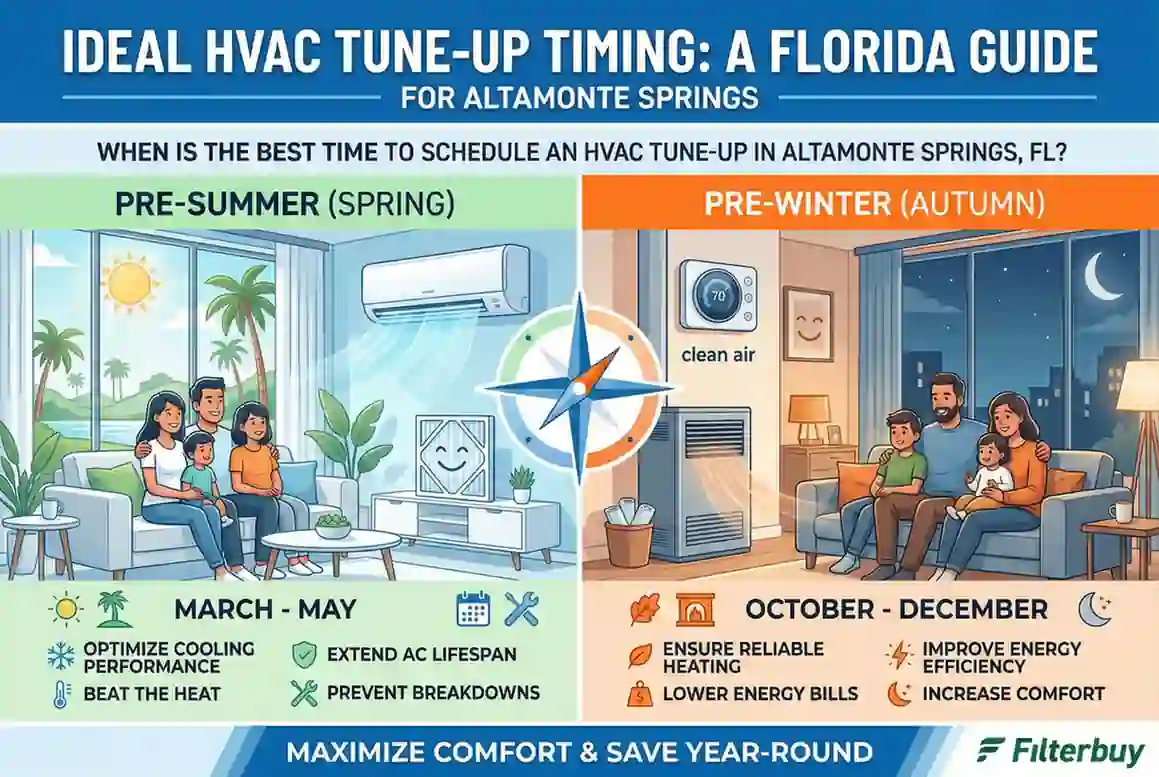
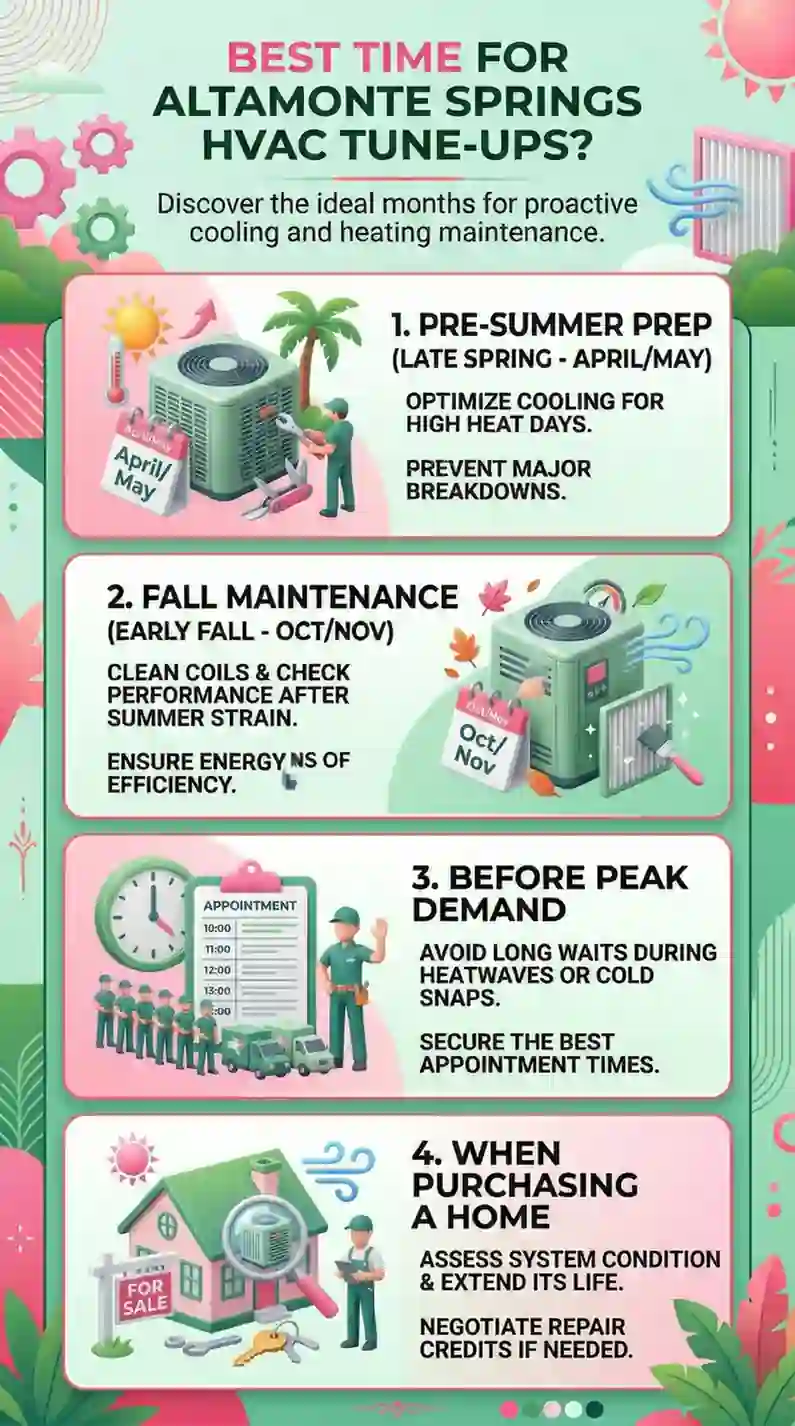
February and March are the optimal scheduling window — before peak season demand eliminates availability
What a top tune-up costs in this market:
Legitimate range: $75 to $150
Below $75 warrants scrutiny
The right provider welcomes credential verification before anyone arrives
Bottom line: The top HVAC tune-up providers are verified, credentialed, and transparent before the first visit. They understand Central Florida's demands — and they welcome the questions that confirm it.
Top Takeaways
Florida's climate makes tune-up timing non-negotiable.
Your system runs 10 to 11 months per year
Humidity accelerates wear faster than national guidelines account for
Standard "spring or fall" advice wasn't written for Altamonte Springs
February and March are your window — and it closes fast.
The best technicians fill pre-season calendars weeks in advance
A tune-up you meant to schedule in April is often a July emergency call you didn't plan for
Verify credentials before anyone touches your system.
Florida DBPR license: required by state law
NATE certification: confirms real-world field competency
EPA 608 certification: legally required for refrigerant handling
A provider who welcomes that scrutiny is telling you something. So is one who doesn't.
Small maintenance tasks carry large compounding consequences here.
Airflow problems alone reduce efficiency by up to 15%
A dirty filter increases energy consumption by 5% to 15%
Coil fouling compounds with every operating hour in a 10-to-11-month season
Prepared homeowners get better outcomes — every time.
Ask for a written checklist before the visit
Confirm guaranteed pricing upfront
Know what a legitimate tune-up includes before anyone arrives
Most national HVAC guidelines recommend scheduling maintenance in March or October. Those recommendations were built around climates where systems sit idle for months at a time — giving components a natural recovery window before the next season of heavy use.
Altamonte Springs doesn't work that way. Three local realities separate this market from the assumptions behind generic timing advice:
No true offseason. Systems here run continuously from roughly February through December — with only a brief period of reduced demand in January.
Humidity never relents. Central Florida's moisture levels accelerate coil buildup, strain drain lines, and create conditions for mold growth year-round — not just in summer.
Peak demand arrives fast. Temperatures in Altamonte Springs climb quickly in spring. A system that isn't serviced before that transition hits peak load without the maintenance it needs to handle it.
Following timing advice designed for Ohio or Minnesota in a Central Florida home doesn't just miss the point — it leaves your system exposed at exactly the wrong moment.
The Single Best Time to Schedule a Tune-Up in Altamonte Springs FL
February through March is the window we consistently recommend to Altamonte Springs homeowners — and the data from our service history explains why.
Systems serviced in this window benefit from several converging advantages:
Demand is still manageable. February and early March sit in the brief window between reduced winter use and the rapid temperature climb that begins in April.
Technician availability is highest. Booking before peak season means more scheduling flexibility, more time for a thorough visit, and no competition with emergency service calls.
Problems caught now cost less to fix. Components that developed wear over the previous cooling season — capacitors, contactors, refrigerant circuits — are identified before they fail under the stress of peak demand.
The system enters its hardest months prepared. A February or March tune-up positions your equipment to handle April through October — the months that determine whether a system lasts 15 years or 10.
After years of tracking service patterns across Central Florida, experienced HVAC companies consistently find that the breakdowns disrupting families in July and August almost always trace back to a February or March window that passed without a maintenance visit.
The Second Maintenance Window Altamonte Springs Homeowners Should Know
October through November represents the second optimal tune-up window — and it serves a different purpose than the spring visit.
By the time October arrives, your system has completed 8 to 9 months of near-continuous cooling work. That operating duration creates specific maintenance needs that a spring visit alone doesn't address:
Coils that have accumulated a full season of buildup
Drain lines that have handled months of continuous condensate production
Electrical components that have cycled thousands of times since their last inspection
Refrigerant circuits that may have developed slow leaks undetectable at the start of the season
A fall tune-up catches the cumulative wear from the cooling season before it compounds over the following year. It also prepares the system for the brief heating period Central Florida does experience — and ensures any issues discovered during lower-demand months are resolved on your schedule, not under emergency conditions.
What Happens When Altamonte Springs Homeowners Wait Too Long
The most expensive HVAC service calls we respond to in this area share a common thread: the homeowner delayed maintenance past the optimal window and the system encountered peak demand without it.
Waiting until summer to schedule a tune-up in Altamonte Springs creates three compounding problems:
Contractor availability drops sharply. June through August is peak emergency season across Central Florida. Wait times for non-emergency service extend significantly — meaning a system that needs attention may run degraded for weeks before a technician arrives.
Minor issues become major failures. A capacitor showing early signs of wear in March is a routine tune-up finding. The same capacitor failing in July is an emergency service call — often on a weekend, at premium rates.
Efficiency losses accumulate. A system running through peak demand without proper coil cleaning, verified refrigerant charge, and measured airflow is operating below designed efficiency at the exact moment energy consumption — and utility bills — are at their highest.
How to Build a Maintenance Schedule That Actually Protects Your Altamonte Springs Home
Based on what we've observed across thousands of Central Florida service visits, the most effective approach for Altamonte Springs homeowners follows a consistent two-visit annual pattern:
Visit 1 — February to March:
Full system tune-up before peak cooling demand
Refrigerant verification and leak testing
Coil cleaning and airflow measurement
Electrical inspection and tightening
Condensate drain line clearing
Visit 2 — October to November:
Post-season assessment after 8 to 9 months of continuous operation
Cumulative wear evaluation on capacitors, contactors, and refrigerant circuits
Coil inspection for buildup that developed over the cooling season
Drain line inspection following continuous summer condensate production
System preparation for the brief heating period ahead
Homeowners who understand the importance of regular maintenance and follow this schedule consistently experience fewer emergency breakdowns, lower utility bills, and systems that reach — and exceed — their expected service life. The ones who don't tend to meet us under less convenient circumstances.
Schedule Your Altamonte Springs HVAC Tune-Up Before the Window Closes
The February through March window is the most valuable maintenance opportunity of the year for Central Florida homeowners — and it closes faster than most people expect. Once April arrives and temperatures begin their climb, technician availability tightens and the system is already under increasing load.
If your last tune-up was more than 12 months ago — or if you're not certain when it was — the right time to schedule is now. Our Altamonte Springs team brings licensed, NATE-certified technicians, a detailed itemized checklist, and transparent pricing to every visit. No pressure, no surprises — just the local expertise your system deserves from neighbors who understand exactly what Central Florida's climate demands.
"Every July, we respond to breakdowns that didn't have to happen. The homeowner delayed the February tune-up, the system carried undetected wear into peak demand, and what would have been a routine maintenance finding became an emergency service call — often on a weekend, at premium rates, in the middle of a Florida summer. After servicing thousands of Central Florida homes, the most important HVAC advice we can offer an Altamonte Springs homeowner isn't about what brand to buy or what SEER rating to chase. It's this: get your system serviced in February or March, before the heat arrives and before every other homeowner in Seminole County is calling for the same technician. The window is shorter than you think, and the cost of missing it is higher than most people expect until they've experienced it firsthand."
Essential Resources
As your neighbors who happen to be HVAC professionals, we know the difference between a homeowner who gets the most out of their tune-up and one who doesn't often come down to preparation. These are the resources we'd point our own family members to before booking any HVAC service in this area — and before the February–March window closes.
1. Confirm Your Contractor Is Legally Authorized to Work in Florida Before You Book
Florida DBPR Contractor License Verification | MyFloridaLicense.com This is the first check we recommend to every Altamonte Springs homeowner — bar none. Florida law requires all HVAC contractors to hold a current, active state license before performing any work, and this official DBPR portal lets you verify that status in under a minute before anyone touches your system. https://www.myfloridalicense.com/wl11.asp
2. Verify Your Technician's Field Competency Before Peak Season Locks Out the Best Providers
NATE Technician ID Verification | North American Technician Excellence NATE certification is the credential we hold our own technicians to — because it reflects real-world working knowledge, not just training hours logged. Use this official verification tool to confirm any technician's active certifications before the February–March booking window tightens and qualified providers fill their schedules. https://natex.org/contractor/verify-a-nate-id
3. Know the Federal Benchmark for What a Pre-Season Tune-Up Should Actually Include
ENERGY STAR Maintenance Checklist | U.S. Environmental Protection Agency This is the independent, government-backed checklist we recommend Altamonte Springs homeowners keep on hand when evaluating any provider's scope of work. If a contractor's tune-up checklist falls significantly short of what ENERGY STAR defines as a complete pre-season visit, that gap tells you something important before you book — not after. https://www.energystar.gov/saveathome/heating-cooling/maintenance-checklist
4. Understand the Specific Tasks That Determine Whether Your System Enters Peak Season Prepared or Compromised
Air Conditioner Maintenance Guide | U.S. Department of Energy After years of servicing Central Florida homes, we can confirm that the tasks the DOE identifies here — verified refrigerant charge, measured airflow, inspected electrical connections — are precisely what separates a tune-up that genuinely protects your system from one that simply generates a receipt. Read this before scheduling any pre-season visit in Altamonte Springs. https://www.energy.gov/energysaver/air-conditioner-maintenance
5. Understand Why Central Florida's Humidity Makes Maintenance Timing More Critical Than Any National Guideline Accounts For
Humidity & HVAC Performance in Central Florida | Florida Solar Energy Center / University of Central Florida This is the local research that validates what we observe in Altamonte Springs homes every week. UCF's Florida Solar Energy Center has studied how Central Florida's persistent humidity directly accelerates HVAC performance degradation — the peer-reviewed scientific context behind why timing your tune-up for February or March matters more here than anywhere else in the country. http://www.fsec.ucf.edu/en/consumer/buildings/basics/humidity.htm
6. Know Seminole County's HVAC Permit Requirements Before Any Work Beyond a Tune-Up Begins
Seminole County Building Division — HVAC Permits & Contractor Registration | Seminole County FL We keep this resource bookmarked because our Altamonte Springs customers deserve to understand the local regulatory framework governing HVAC work in their homes. Seminole County's Building Division outlines contractor registration requirements, permit thresholds, and inspection processes — the local rules that protect you when any work goes beyond routine maintenance. https://www.seminolecountyfl.gov/departments-services/development-services/building
7. Know Your Rights and Your Recourse as an Altamonte Springs Homeowner Before You Need Them
Contractor Hiring Guidelines & Complaint Process | City of Altamonte Springs Building & Fire Safety Department This is the resource we wish every homeowner in our community had read before a bad experience — not after. The City of Altamonte Springs Building and Fire Safety Department outlines your rights as a homeowner, local HVAC work thresholds, and the official complaint process for substandard or unlicensed contractor work. Know this before the busy season begins, not during it. https://www.altamonte.org/faq.aspx?TID=16
These trusted state, federal, and local resources help Altamonte Springs homeowners prepare for a top HVAC system tune up by verifying contractor licensing and certifications, understanding federally defined maintenance standards, recognizing Central Florida’s humidity demands, and knowing the local permit and consumer protections that ensure your system enters peak season fully prepared and professionally maintained.
Supporting Statistics
We don't share these statistics to make a sales pitch. We share them because they reflect exactly what we see on the job — in Altamonte Springs attics that hit 130 degrees in August, on systems that have been running nearly every day since March. Federal research confirms what we've already learned the hard way on your streets.
In Florida, air conditioning accounts for 28% of total home energy use — more than four times the national average.
The U.S. Energy Information Administration's Residential Energy Consumption Survey makes the contrast clear:
National average: ~9% of home energy goes to cooling
Florida average: 28% of home energy goes to cooling
We see this number every time a homeowner shows us their FPL bill in July and can't understand why it keeps climbing. Here's what years inside these homes has taught us:
A system that's slightly underperforming bleeds efficiency gradually
Most homeowners never connect the bill to the equipment until peak season
By then, appointment availability is gone and the system is already stressed
A February tune-up lets us catch and correct inefficiencies before they show up on a bill you can't do anything about.
Source: U.S. Energy Information Administration, 2020 Residential Energy Consumption Survey — Highlights for Air Conditioning in U.S. Homes by State https://www.eia.gov/consumption/residential/data/2020/state/pdf/State%20Air%20Conditioning.pdf
Airflow problems alone can reduce a system's efficiency by up to 15%.
We've crawled through enough Seminole County attics to know: airflow problems are the quiet culprit behind more comfort complaints than almost anything else. ENERGY STAR's federal maintenance checklist — the benchmark we train against — documents that airflow issues can cut efficiency by up to 15% before anything else is even wrong.
In Altamonte Springs homes, this is what that looks like in practice:
Blower components coated from months of running through humid air
Evaporator coils with buildup that accumulates faster than drier climates
Return duct systems undersized for year-round demand since the 1990s
The difference in outcome is straightforward:
Caught in February: routine fix, minimal cost
Found in mid-July: emergency call, maximum stress
Source: ENERGY STAR Maintenance Checklist — U.S. Environmental Protection Agency https://www.energystar.gov/saveathome/heating-cooling/maintenance-checklist
Proper maintenance practices can reduce annual energy costs by 5% to 20% — without replacing any equipment.
The U.S. Department of Energy's Better Buildings Solution Center confirms what we've been telling Altamonte Springs homeowners for years. Consistent, qualified maintenance is one of the most cost-effective interventions available. No new equipment. No major investment.
We've seen both sides of this pattern play out firsthand:
Homeowners who schedule in the February–March window tend to:
Have systems that run efficiently season after season
Face fewer mid-summer surprises
Spend less on repairs over the life of the equipment
Homeowners who skip years tend to:
Call us in June or July with a system already under stress
Face repair bills that would have cost far less as a February maintenance check
Lose appointment availability exactly when they need it most
Source: U.S. Department of Energy, Better Buildings Solution Center — Preventative Maintenance for HVAC Equipment https://betterbuildingssolutioncenter.energy.gov/solutions-at-a-glance/preventative-maintenance-commercial-hvac-equipment
Replacing a dirty, clogged filter with a clean one can lower energy consumption by 5% to 15%.
This is the statistic we return to most often with homeowners — because it shows what gets lost in conversations about major repairs and replacements. Small maintenance tasks carry large compounding consequences when skipped in a climate like ours.
The Department of Energy documents the chain reaction directly:
Dirty, clogged filter reduces airflow and system efficiency
Restricted airflow forces the system to work harder
Dirt bypasses the filter and accumulates on the evaporator coil
Coil buildup compounds the efficiency loss with every operating hour
What makes this especially relevant for Altamonte Springs: our 10-to-11-month operating season means fouling accumulates faster than national averages account for. Filter and coil conditions that's acceptable in March become a real performance problem by June — not because anything failed, but because of continuous operation in humid conditions.
When our technicians arrive in February, filter and coil condition are the first two things we check. They tell us more about the next eight months of performance than almost anything else on the system.
Source: U.S. Department of Energy — Maintaining Your Air Conditioner https://www.energy.gov/energysaver/maintaining-your-air-conditioner
Final Thought & Opinion
We've been inside enough Central Florida homes to have a perspective no federal guideline or national average can fully capture. So here it is — straight from the field.
Most HVAC tune-up problems in Altamonte Springs aren't caused by bad equipment. They're caused by good equipment that wasn't given a fair chance.
We see the same pattern consistently:
System installed correctly, maintained for a few years
Gradually deprioritized as life got busy
No dramatic failure — just slow accumulation of what this climate specializes in creating
Coil buildup, stressed drain lines, restricted airflow
A $150 February tune-up becomes a $600 July repair
The "tune-up special" conversation in this market is framed backwards.
Most content online positions a tune-up as something you do when you're worried about your system. In our experience, that framing misses the point entirely — especially here.
In Altamonte Springs, a tune-up isn't a precaution. It's the single most leveraged maintenance decision a homeowner can make because:
Your system runs 10 to 11 months per year
Humidity accelerates wear faster than any national schedule accounts for
The window to act before peak season closes faster than most expect
The best technicians fill February and March calendars weeks in advance
The homeowners we worry about aren't the ones asking whether a tune-up is worth it. They're the ones who decided it wasn't worth the call.
We've had this conversation too many times:
Homeowner planned to schedule something in the spring
April arrived faster than expected
Suddenly it was June and the system was already struggling
No appointment availability — and a family without reliable cooling in a Central Florida summer
That's not uncomfortable. In this climate, it's a genuine health and safety concern — especially for families with young children, elderly parents, or anyone with respiratory sensitivities.
Our recommendation is the same one we'd give our own neighbors — because in most cases, that's exactly what you are.
Schedule in February or March
Verify your contractor's credentials before anyone touches your system
Ask for a written checklist before the visit begins
If a provider resists any of those three requests, that resistance tells you everything you need to know
A legitimate tune-up from a verified, NATE-certified technician who understands Central Florida's demands isn't an expense. Over the life of your equipment, it's the closest thing to a guarantee that your system will be ready when your family needs it most.
That's not a sales position. That's just what the work has taught us.
FAQ on Top HVAC System Tune Up Near Altamonte Springs FL
Q: How much should an HVAC tune-up cost near Altamonte Springs FL?
A: Expect to pay between $75 and $150 for a legitimate tune-up in this market.
What that range tells us from the field:
Below $75 is where bait-and-switch patterns appear most often
Low entry pricing is how unverified providers get in the door
The tune-up becomes a vehicle for upselling repairs your system may not need
A fair price from a verified provider protects you on the bill and the upsell
We've seen what happens when homeowners chase the lowest number. The savings rarely survive the service visit.
Q: What should an HVAC tune-up include near Altamonte Springs FL?
A: A legitimate Central Florida tune-up must include all of the following:
Refrigerant level check and leak inspection
Evaporator and condenser coil cleaning
Blower component cleaning and adjustment
Drain line clearing and condensate pan inspection
Electrical connection tightening and voltage measurement
Thermostat calibration and system controls check
Airflow measurement across the evaporator coil
Two items matter more here than anywhere else:
Coil condition — Altamonte Springs humidity accelerates buildup faster than national averages
Drain line health — Continuous condensation in this climate stresses drain lines year-round
If a provider's checklist doesn't address both specifically, ask why before the visit begins.
Q: When is the best time to schedule an HVAC tune-up near Altamonte Springs FL?
A: February and March. The timing matters more here than almost anywhere else.
Here is what we see play out every year:
Systems run 10 to 11 months continuously in this climate
April temperatures climb fast and technician availability tightens with them
February callers get the best availability, most thorough service, and longest runway before peak demand
Homeowners who wait until April are often calling us in July instead
Secondary window: October and November for a post-season check after months of continuous operation.
Standard national advice to schedule "in spring or fall" was not written for Central Florida. February is the window we would tell our own family to use.
Q: How do I verify an HVAC contractor is legitimate near Altamonte Springs FL?
A: Run these three checks before anyone arrives at your home:
Florida DBPR License — Verify at MyFloridaLicense.com. Required by state law. Takes under a minute.
NATE Certification — Verify at natex.org. Confirms real-world field competency, not just training hours logged.
EPA 608 Certification — Required by federal law for anyone handling refrigerant. No certification means no legal authority to complete your tune-up.
What the response tells you:
Provider welcomes all three checks without hesitation = strong signal of legitimacy
Provider deflects, delays, or redirects = the most useful information they will give you
We built our own hiring standards around these same three credentials.
Q: How do I know if an HVAC tune-up special near Altamonte Springs FL is a bait-and-switch?
A: Ask these three questions before you book — not after the technician leaves:
Will you provide a written checklist of everything included?
Legitimate providers send this before arrival
Bait-and-switch providers keep scope vague on purpose — the ambiguity is the strategy
Is the advertised price guaranteed or a starting point?
Defined pricing signals a legitimate operation
An open-ended starting price means the real transaction hasn't started yet
Can you verify your NATE certification and Florida DBPR license before we schedule?
Credible providers confirm without hesitation
Less credible providers deflect, delay, and redirect
The homeowners who ask these three questions before booking consistently avoid the experiences that generate one-star reviews. The ones who skip the questions are usually the ones writing them.
In When Is the Best Time to Schedule an HVAC Tune-Up in Altamonte Springs FL?, we explain that the smartest timing is before peak demand ramps up, so you can lock in better scheduling, catch airflow and drain issues early, and head into the hottest stretch with a system operating at its best. A big part of making that tune-up “stick” is having the right filter already in place (or ready to swap), whether that’s a 16x30x1 pleated furnace filter, a 16x20x1 MERV 8 air filters 6-pack for consistent changeouts during a long cooling season, or a MERV 11 pleated HVAC air filter for systems designed to support finer particle capture, so your service visit translates into steadier comfort, cleaner operation, and fewer mid-season surprises.